Stress, Sleep and Desire: The Connection Most People Notice Before Anyone Explains It
People usually arrive at this subject the long way round. Something has changed, they cannot say precisely what, and it does not feel like a medical problem. In surveys of what people report as the cause, two answers come up far more often than any other: being permanently tired, and being permanently stressed.
That is not a coincidence, and it is not a character flaw. It is physiology.
What stress actually does
The stress response is a system for dealing with short, survivable threats. It raises heart rate, redirects blood flow toward muscle, releases glucose, and suppresses everything the body considers non-urgent for the next few minutes.
Reproduction is on that non-urgent list. This is well established: sustained elevation of cortisol is associated with reduced testosterone and altered gonadotropin signalling, and chronically elevated stress is one of the more consistent correlates of lowered sexual interest in both men and women.
That suppression strategy is sensible for a threat lasting minutes. It becomes counterproductive when the “threat” is a job, a mortgage or a phone that never stops.
The sleep half of the equation
Sleep loss and stress are not independent. Each makes the other worse, which is why the two so often appear together.
What is reasonably well supported:
- Testosterone is produced largely during sleep, with a substantial share released during the first REM period. A week of restricted sleep produces a measurable drop in daytime levels in healthy young men.
- Sleep restriction increases cortisol the following evening.
- Sleep loss reliably degrades mood regulation, which changes how people interpret their own lack of interest — a tired person is much more likely to read a normal fluctuation as a problem, which adds another layer of stress.
The practical implication is uncomfortable but useful: for a lot of people the intervention is sleep, not effort. Trying harder while exhausted is a reliable way to make things worse.
What the evidence supports
Ordered roughly by how strong the evidence is, not by how appealing the intervention is.
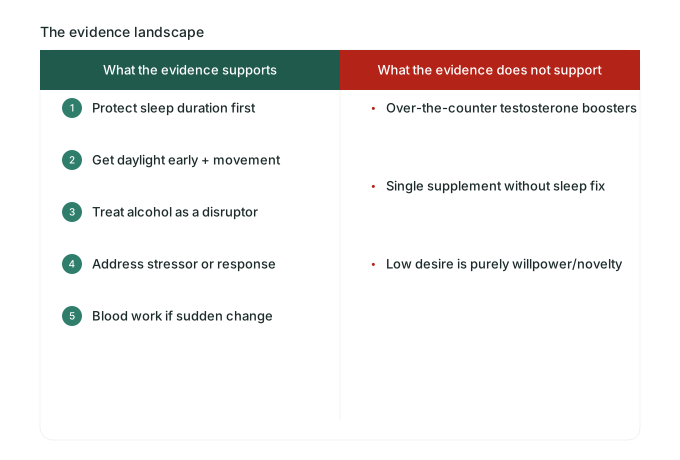
1. Protect sleep duration first. A consistent sleep and wake time, seven to nine hours, dark and cool room. This is unglamorous and it has the best evidence of anything on this list.
2. Get daylight early and movement during the day. Morning light is the strongest available signal for anchoring the circadian rhythm. Regular moderate exercise has a modest but real positive association with sexual function, and it improves sleep quality.
3. Treat alcohol as a sleep disruptor, not a relaxant. A drink may shorten the time it takes to fall asleep. It also suppresses REM, fragments the second half of the night, and lowers testosterone. People who track this consistently find the net effect is negative even when it feels positive.
4. Address the stressor, or address the response. Where the stress has a concrete cause, changing it beats managing it. Where it does not, the evidence-supported approaches are structured: cognitive behavioural therapy, mindfulness-based programmes, and — for sleep specifically — CBT-I, which outperforms medication for chronic insomnia over the long term.
5. Get the blood work done if something changed suddenly. Thyroid function, iron, vitamin D, blood glucose and hormone panels are cheap, fast, and eliminate a whole category of explanation. A sudden change with no obvious cause is worth investigating rather than assuming.
What the evidence does not support
Worth stating plainly, because this category is commercially noisy:
- “Testosterone boosters” sold without prescription have, at best, weak and inconsistent evidence, and at worst unlisted ingredients.
- A single supplement taken without addressing sleep debt rarely does what people hope.
- The idea that low interest is always psychological, and therefore always solvable by willpower or novelty, ignores the physiology above.
A realistic sequence
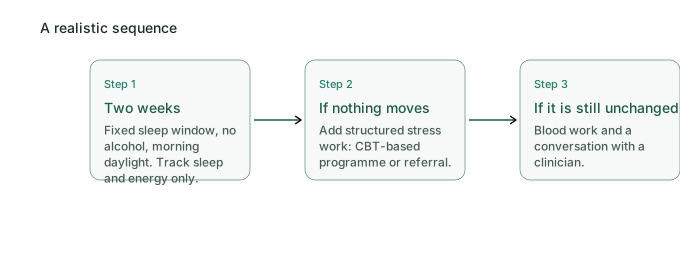
If you want an order of operations, this is a defensible one:
- Two weeks. Fixed sleep window, no alcohol, morning daylight. Track only sleep and energy, not the thing you are worried about.
- If nothing moves. Add structured stress work — a CBT-based programme, or a referral.
- If it is still unchanged. Blood work, and a conversation with a clinician. Persistent change in desire or function can be an early marker for cardiovascular, endocrine or mood conditions, and is worth investigating on its own merits.
That last point is the one we would most want someone to take away. This is frequently a signal rather than a problem in itself, which is why it deserves a proper look instead of a supplement.