Five Communication Habits That Predict Relationship Satisfaction Better Than Compatibility
The intuitive model of a good relationship is a compatibility model. You find someone who wants the same things, and the relationship works because you match.
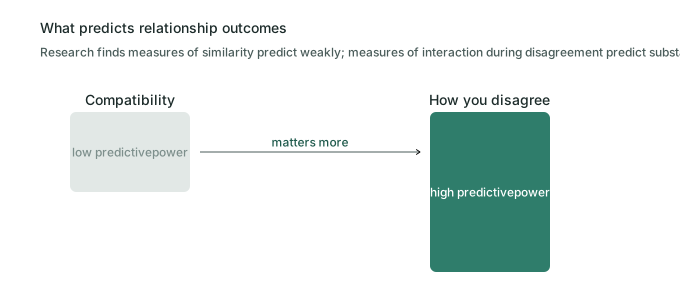
Longitudinal research on couples points somewhere less romantic. Measures of similarity — personality, interests, background — predict relationship outcomes weakly. Measures of how partners interact during disagreement predict them substantially better. The same fights happen in relationships that last and relationships that do not. What differs is how they are conducted.
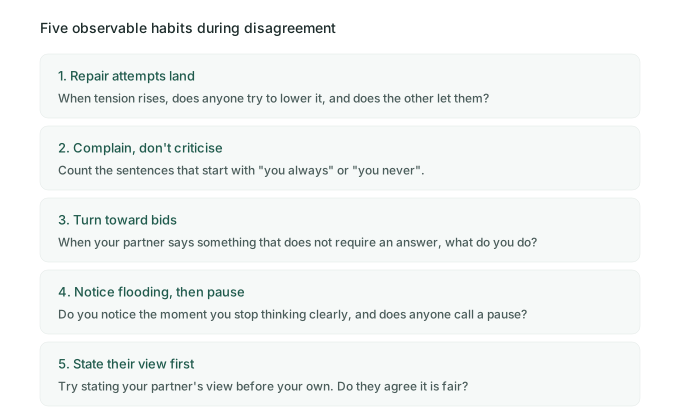
Below are five habits that show up repeatedly in that literature. They are observable, which is what makes them useful — you can notice yourself doing them, or not doing them.
1. Repair attempts, and whether they are accepted
A repair attempt is any move that de-escalates during friction: a joke, a softened tone, an admission of being partly wrong, a change of subject, a hand on the arm.
The important finding is that the content of the repair matters less than whether it lands. Couples who stay together make and accept repair attempts at higher rates; couples who struggle make them and miss them. Missing them tends to compound — a repair attempt that fails usually escalates matters, because it reads as rejection on top of the original disagreement.
The observable version: when tension rises, does anyone try to lower it, and does the other person let them?
2. Criticism of behaviour versus criticism of character
Complaints about what someone did are not the same as claims about who they are. “There were dishes in the sink again” is a behavioural statement that can be acted on. “You never think about anyone but yourself” is a character claim, and it invites defence rather than change.
Research on conflict distinguishes complaint from criticism precisely here. The first is normal and often necessary. The second predicts deterioration, because it reframes a specific incident as evidence about a person’s worth.
The observable version: count the sentences that start with “you always” or “you never”.
3. Turning toward bids
A bid is a small request for attention — a comment about something seen out of the window, a sigh, a question about the day. Turning toward means responding: looking up, engaging, acknowledging.
The finding that surprises people is scale. In observational work, couples who remained together turned toward their partner’s bids at a much higher rate than couples who separated — and the bids themselves were almost entirely trivial. The pattern is built out of unremarkable moments, not grand gestures.
The observable version: when your partner says something that does not strictly require an answer, what do you do?
4. Regulated versus flooded
Physiological flooding — heart rate up, adrenaline, the feeling of being unable to think clearly — makes productive conversation physically difficult. Under flooding, people become less accurate at reading the other person and more likely to say things they do not mean.
Couples who handle conflict well more often take a break before that point, and come back. It is not avoidance; it is sequencing. A twenty-minute break with a genuine return is different from walking out, and the difference is whether you come back.
The observable version: do you notice the moment you stop thinking clearly, and does anyone call a pause?
5. Ownership of the other person’s perspective
This is the habit that correlates most strongly with satisfaction in the research on what makes partners feel understood: the ability to state the other person’s position accurately, in a way they would recognise as fair, without conceding your own.
It is not agreement. It is demonstrated comprehension. People who feel accurately understood fight less about the same things, because the disagreement is narrower than it appeared — often it turns out the fight was about being heard rather than about the original subject.
The observable version: try stating your partner’s view before your own. If they say “that’s not what I meant”, you have something to work with.
What this list is not
These are patterns from research on couples, not a guarantee, and not a diagnosis of your relationship. A partner who is consistently contemptuous, controlling, or who makes you feel unsafe is not a communication-habits problem, and no technique on this list addresses it. That situation calls for support from outside the relationship, and possibly from a professional.
For everyone else — which is most people, most of the time — the useful takeaway is that the list is boring. Repair attempts, complaint instead of criticism, turning toward bids, taking a break, restating the other perspective. None of it is dramatic, and all of it is observable, which means it is practiceable.